A Love Letter to the South
Cotton, Culture & Consequence
Follow a bale beyond the field and a whole network of labor, credit, and power comes into view.
Land and memory
When I think about cotton in Arkansas, I think first of the lowlands. The Delta and the hill country of the Ozarks and Ouachitas belong to the same state, but a farmer in one could hardly take the conditions of the other for granted. Level, fertile ground could support large-scale cotton production. Moving that cotton took access to a gin, a landing, and somebody willing to advance the cost of a season. A crop helped determine where towns grew and who had business there. [1]
My original paper brought a family account of Caswell Walker Bradley into that larger story. Family recollection can preserve a name and a connection to a place that an economic history would have little reason to record. It cannot, by itself, establish the terms on which land changed hands. I want to keep the account for what it tells me about the way a family remembers land, while leaving that question open.
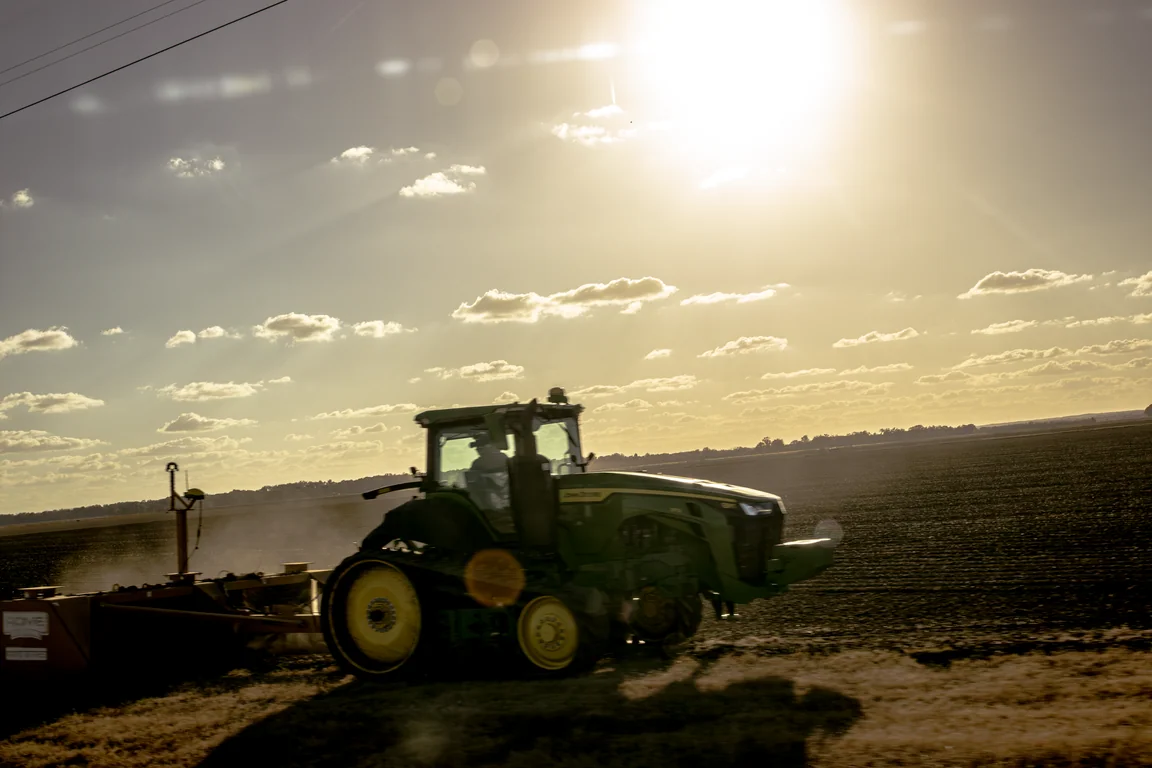
Dust behind a tractor brings the work of a field into view. The crop in this photograph is unidentified.
The people behind a bale
A bale had a price by the time it reached the market. The people whose work gave it that value had very different claims on the proceeds. Before emancipation, enslaved people planted, tended, and picked cotton under coercion. After emancipation, freed families sought control over their time and their livelihoods. Tenancy and sharecropping offered ways to farm without buying land outright. They also left many families dependent on a landowner or merchant for supplies until the harvest. [1][2]
The difference between renting land and working for a share mattered. So did the question of who kept the accounts. A family might put in a full year, then discover at settlement that the crop had hardly covered the advance. A fall in cotton prices narrowed the margin still further. Dependence on one crop became a problem shared across the region, with the hardship falling unevenly on owners, tenants, and laborers. [2]
What the accounts reveal
Following the accounts also changes what counts as a source. A family story may explain why a particular field matters to someone; an economic history may explain the system of credit surrounding that field. Neither can simply stand in for the other. Keeping the two in conversation allows a personal connection to guide the questions without allowing it to settle a disputed fact.
This is why the landscape alone cannot tell the whole story. A field can look orderly even when the arrangements behind its cultivation are profoundly unequal. Asking who could leave, bargain, keep a record, or challenge a settlement brings people back into a view that might otherwise contain only land and crops. The rows remain visible; the work of history is to make the relationships behind them legible as well.
Looking beyond the rows
In Phillips County in 1919, Black farmers organizing for fair settlement of their cotton accounts faced murderous racial violence in what became known as the Elaine Massacre. The effort to get paid belonged to the history of agriculture just as surely as gins and steamboats did. It is easy to see rows in a field from the road. It takes another kind of looking to see who owned the crop, who carried the debt, and who could safely ask to see the books. [3]
References & publication notes
- Encyclopedia of Arkansas, Post-Reconstruction through the Gilded Age
- Encyclopedia of Arkansas, Sharecropping and Tenant Farming
- Encyclopedia of Arkansas, Elaine Massacre of 1919
- Original submission
- Cotton Culture: Arkansas’s Roots
- Course
- Submission cover lists Cultural Psychology (PSYC-3040-10A). Course attribution awaits confirmation.
- Academic context
- Sarah reports that her professors graded the original coursework and awarded A grades. This expanded publication edition follows that assessment.
- Revision
- Separates family recollection from documented history and distinguishes tenancy from sharecropping. This edition adds section headings and develops the discussion. Earlier public PDFs are preserved separately.